



Navigating turbulence, building capability and leading change in Health and Care
The health and social care sector in England is under significant pressure. We experience it as service users. Staff confront it every day across frontline services. Executives and Boards encounter it in the impossibly high number of agenda items and the constant tension between today’s realities and tomorrow’s aspirations.
The data shows it clearly. The waiting list for hospital treatment rose to a record 7.7 million in September 2023. Only one in five NHS organisations is considered digitally mature at a time when the system is expected to deliver major shifts in care. And earlier this year, the Care Quality Commission reported that health and social care is fragmented and under severe strain, whilst at the same time trying to prepare for a significant shift from hospital to neighbourhood care.
The aspirations are right. The shifts identified by Darzi are urgent and necessary. Yet the capacity of the system and the leaders within it remains constrained. This leaves us with an essential question.
In a world of constant turbulence and disruption, where the work cannot pause, how do we develop leaders capable of reshaping the system?
CoCreate was founded 10 years ago with this question at the heart of our work. Over the last decade, we have developed board leadership, system leadership, executive team development and coaching programmes, all built on our philosophy of Applied Development.
Applied Development means that development happens inside real challenges. Leaders make progress on live issues, strengthen relationships, build trust and shift patterns in the system as part of the development process itself. We have seen this approach deliver results across 12 ICS footprints, working with providers, commissioners, local authorities, education partners and community organisations.
There are many success factors, but three core capabilities underpin our work. These capabilities help leaders build hope, support progress and strengthen system leadership even when the wider system is under strain.
1. Developing leadership resilience
When systems are under pressure, the focus often turns to efficiency. Efficiency helps with today’s challenges, but it does not build the capacity needed for tomorrow’s change. Leadership resilience becomes vital because it creates space for reflection, adaptation and new thinking.
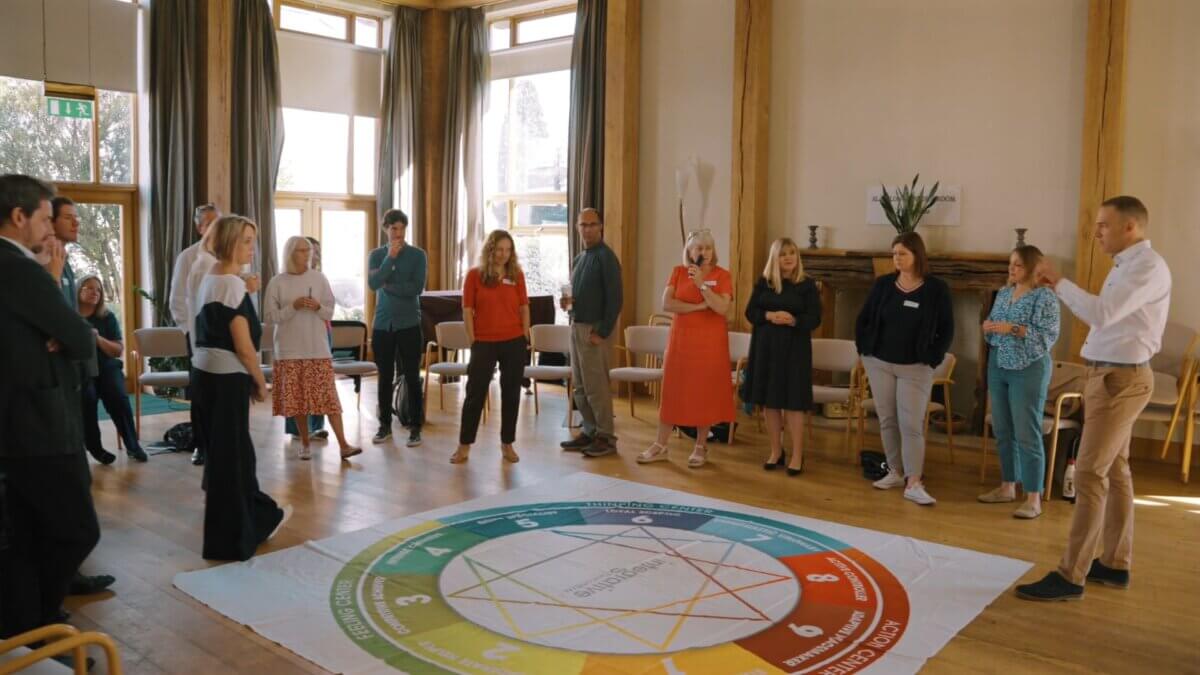
Resilience begins with self-awareness. Not self-awareness in theory, but awareness in the work. Leaders need to understand how they show up under pressure, what drives their behaviour, the patterns that help or hinder them, the triggers that take them off course and the strategies that support their best leadership.
This is difficult. A Harvard Business Review study of 3,600 leaders found that only a small minority (less than 15%) were genuinely self-aware. The more senior the role, the less feedback leaders typically receive and the greater the risk of blind spots.
Our philosophy is simple. You cannot transform systems without transformational leaders. Transformation requires self-awareness, emotional regulation and the capacity to lead well under pressure.
Tools such as the iEQ9 Enneagram play a crucial role. They offer powerful, evidence-based insight into stress patterns, motivations and blind spots.
I have worked with many self-assessments over the years. They all offer a framework for team building, but the iEQ9 is the first tool that has resonated powerfully with my own sense of self and with motivations that are often hidden and not always comfortable. I observed it speak to each member of my team and lead to some of the most open, honest, brave but respectful discussions I have been in.
Robert Woolley, former Chief Executive, University Hospitals Bristol and Weston
Resilience grows when leaders understand themselves and when they understand one another. That is how individual awareness becomes collective leadership resilience.
2. Building psychological safety across networks
Interdependence defines today’s NHS. Services cannot operate in isolation. Most system challenges involve multiple organisations, professions and perspectives. This makes collaboration essential, but also complex.
Tools and frameworks for navigating complexity are helpful. We use many of them, including Adaptive Leadership, Three Horizons and Systemcraft. However, tools alone will not suffice. People have to do the work and that requires psychological safety.
Psychological safety creates the climate where leaders can name conflicts, surface tensions and speak honestly about risks and constraints. At NHS Confed last year, Amy Edmondson urged leaders to make major challenges discussible, to name binds when they arise, to invite others into the problem-solving process and to focus on what can be influenced.
These ideas run through our work. Leaders regularly tell us that the environments we create enable deeper trust, braver conversations and more collaborative decisions.
Running an Executive Programme alongside wider leadership development has been transformational. It has deepened self-awareness, built trust and enabled us to have robust conversations about complex issues. This is already influencing how we lead, collaborate and plan for the future.
Dr Sarah Munro, Chief Executive, Leeds and York Partnership NHS Foundation Trust
Psychological safety across networks is essential for any system that wants to make meaningful progress.
3. Building agile leadership for collective action
Long-term planning, detailed governance and risk analysis all matter, but when used in isolation, they can slow systems down. Health and social care leaders need the capacity to act, learn and adapt in real time.
Agility is not speed for its own sake. It is the ability to test ideas, gather insight and adjust course together. Many of the tools we introduce, from Design Thinking to Three Horizons, help leaders build this adaptive capability. The real shift happens when leaders apply these tools to shared challenges in a safe and supported environment.
This is how we see collective action take shape. Leaders move from talking about change to practising change. They learn to make informed choices quickly, gather real-world data and iterate together.
The impact is tangible.
The system change projects developed through the 20/20 Leadership Programme have contributed to improvements in care, including reduced length of stay, reduced ambulance conveyances, significant advances in virtual healthcare and better medicine management between hospitals and the community. Many participants have also stepped into wider system leadership roles as a result.
Alex Whitfield, Chief Executive, Hampshire Hospitals NHS Foundation Trust
Agile leadership is what turns collaboration into progress.
Ten years of learning, ten years of commitment

Over the last 10 years, we have learned that leadership development only drives change when it sits inside the real work and strengthens the real relationships that shape a system. We have seen how self-awareness fuels resilience, how psychological safety unlocks collaboration and how agile leadership turns ambition into progress.
As the system prepares for the Darzi left shifts, our focus for the next decade is clear. We will continue to help leaders build the capabilities that transform pressure into progress and complexity into collective action.
Cutting-edge Leadership, Executive Team & Board Development for Health and Care
At CoCreate, we work with leaders who are ready to do things differently – to unlock collaboration, embrace risk and make progress on the challenges that matter most.
We bring challenge, adventure and creativity to every partnership, helping leaders and teams see differently, act bravely and co-design the conditions for transformation that lasts.
If you would like to explore how CoCreate can support your leaders, teams or system, we would be glad to talk or you can view our Health and Care Brochure for more information: