



How to improve collaboration in the workplace
Let’s be honest, collaboration is one of those words that gets thrown around a lot in organisations. It appears in values statements, strategy decks and job adverts. But ask people what it actually feels like day to day, and the picture is often messier than the glossy brochures suggest.
The truth is, genuine collaboration is hard. It requires trust, good communication, clear roles, strong leadership and the right conditions to thrive. Get it right, though, and the benefits are extraordinary for your people, your culture and your bottom line.
In this piece, we explore why collaboration is important in the workplace, the real challenges that get in the way, and practical ways to improve teamwork and collaboration across your organisation.
Why is collaboration important in the workplace?
The pace of change in modern organisations is relentless. Whether you’re dealing with digital transformation, shifting market conditions or the complexity of managing hybrid teams, most of the challenges leaders face cannot be solved by individuals working alone. Think about the most pressing challenges facing many of the health and care organisations we work with: reducing unnecessary emergency department attendances, accelerating hospital discharge, tackling diabetes or improving neighbourhood health. These are not problems any single team or organisation can solve alone – they demand genuine collaboration across systems, services and sectors.
As we explore in our piece on How Psychological Safety Drives Performance, today’s employees spend around 50% more time in collaborative activities than they did two decades ago (Cross and Grant, Harvard Business Review). That figure alone tells you how central collaboration has become to the way we work.
But it’s not just about the quantity of collaboration, it’s about quality. When people work together effectively, organisations benefit from:
- Faster problem-solving and better decision-making
- Increased innovation and creative thinking
- Higher employee engagement and wellbeing
- Stronger organisational resilience and agility
- Better outcomes for clients, patients and stakeholders
The evidence is compelling: organisations that prioritise collaboration are five times more likely to be high-performing, and teams that work collaboratively show a 50% increase in innovation. Employees in genuinely collaborative environments also report significantly higher engagement and are 64% more productive than those working in isolation (Runn; ProofHub, 2025).
We’ve seen this play out directly in our work at CoCreate. When we partnered with Immediate Media’s Extended Leadership Team during a period of significant digital transformation, the results were clear: 91% of leaders reported greater trust and psychological safety, and 91% said the programme increased the effectiveness of their leadership community. As CEO Sean Cornwell reflected, the work led to “better conversations, stronger challenge, and it genuinely drives performance.” When the conditions for collaboration are in place, things move faster, people feel better and results follow.
Challenges of collaboration in the workplace

If collaboration is so valuable, why is it so difficult? It’s a question we get asked regularly, and the honest answer is that collaboration challenges are deeply human in nature. They’re not primarily about tools or processes, they’re about relationships, trust and culture.
Here are some of the most common collaboration challenges we see:
1. Lack of psychological safety
One of the most significant yet least discussed barriers to collaboration is fear. Fear of saying the wrong thing, of being judged, of rocking the boat. Research consistently shows that 85% of employees have held back a concern at work despite believing it to be important (Milliken, Morrison and Hewlin, Institute for Public Relations). That silence is costly: it represents ideas unshared, problems unseen and talent untapped.
When people feel psychologically safe, when they believe they can speak up without facing negative consequences, collaboration becomes possible. Without it, what often passes for collaboration is merely people going through the motions without any stretch, challenge, rigour or drive for improvement.
2. Siloed thinking and organisational structure
Organisational structures can unintentionally create walls between teams, departments and functions. People naturally develop loyalty to their own team’s priorities, which makes it harder to collaborate across boundaries. This is especially true in large, hierarchical organisations where decision-making is slow and information doesn’t flow freely.
Part of what makes silos so sticky is that they serve a deeply human purpose. As Dr Kate Simpson of Systemcraft argues, one of the core drivers of human motivation is autonomy. Collaboration, by its very nature, asks us to give some of that up. It is far easier to work within a small, trusted team where the rhythms are established and the dynamics are known. Asking people to reach across organisational boundaries throws all of this into the air. It’s hardly surprising, then, that people resist it.
The challenge often isn’t a lack of goodwill, it’s the way organisations are structured. Each team and function typically operates with its own KPIs, budgets and metrics, and these individual incentives can unintentionally disincentivise collaborative working. This is particularly visible in healthcare, where different organisations are commissioned separately to deliver services against a fixed set of targets. Yet these targets rarely account for the handoffs and interdependencies between services, and it is precisely at these junctions, as patients move from one service to the next, that the experience most often breaks down.
3. Poor communication
When people ask how to improve communication and collaboration in the workplace, they’re often responding to a symptom of a deeper problem. Poor communication is rarely about a lack of email or messaging tools. It’s about unclear expectations, insufficient feedback loops and an absence of structured ways of working together.
In our work on feedback culture, we describe a healthy communication environment as one where feedback flows continuously, top-down, bottom-up and peer-to-peer, rather than being confined to annual appraisals or performance reviews. Building those communication rhythms takes intentional design.
4. Collaboration overload
Here’s a paradox: sometimes collaboration doesn’t work because there’s too much of it. Research from Harvard Business Review found that in many organisations, around 80% of working time is spent in meetings or responding to colleagues’ requests, leaving little room for focused individual work (Cross, Rebele and Grant, 2016).
What makes this more complex is that collaborative workload is often deeply unequal. A small proportion of people, typically the most capable and generous, carry a disproportionate share of the collaborative burden, leading to burnout and disengagement. So when people ask why collaboration doesn’t work, this imbalance is often part of the answer.
5. Lack of trust between people and teams
What makes collaboration difficult, more than any other single factor, is a lack of trust. Trust takes time to build and can be damaged quickly. In teams that have experienced conflict, poor leadership or high turnover, rebuilding the relational foundation needed for genuine collaboration requires deliberate investment.
Understanding how individuals are wired, what motivates them, what they fear and how they show up under pressure is a powerful way to accelerate trust-building. It’s one of the reasons we use the iEQ9 Enneagram tool in our leadership and team development work: it gives people real human insight into themselves and each other.
How to improve collaboration in the workplace: practical steps
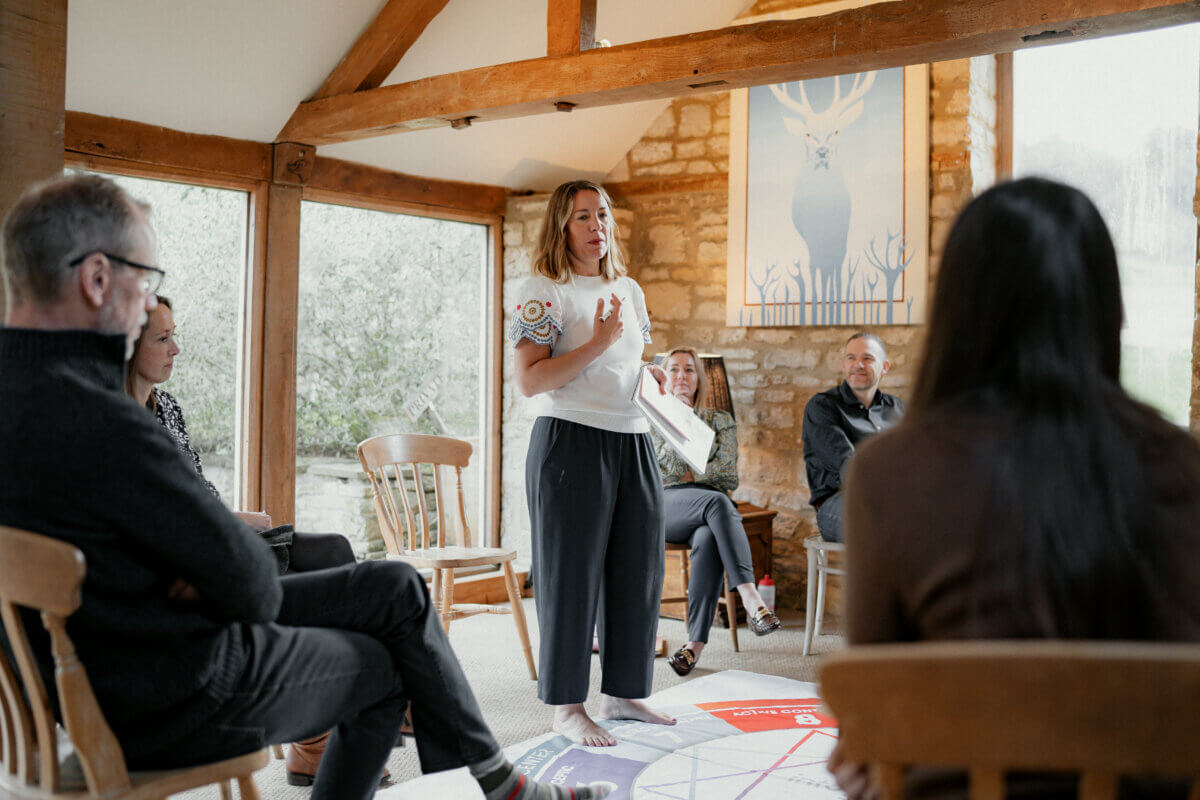
Improving team collaboration in the workplace isn’t about implementing a new tool or running a one-off away day. It requires a sustained focus on culture, leadership and ways of working. Here’s what we’ve seen work consistently across the organisations we partner with.
Invest in relationships
You can’t collaborate effectively with someone you don’t know. This sounds obvious, but many organisations underinvest in the relational fabric that makes collaboration possible. Time spent helping people to genuinely understand each other – their strengths, their blind spots, their working styles – is never wasted. The Trainline CEO reflected after working with us that it was the ‘standout best event’ in 20 years of working with teams, precisely because it helped people go to a deeper level of understanding.
Build shared purpose and clarity
People collaborate better when they understand and connect to a shared goal. Clarity of purpose at team, department and organisational level aligns energy and reduces the friction caused by competing priorities. If your people are collaborating across teams, make sure they understand not just their own objectives but the broader ‘why’ that connects them.
Create the conditions for psychological safety
Everything else becomes possible when people feel safe. Leaders play a central role here. Not by simply asking people to ‘be more open’, but by modelling vulnerability themselves: admitting mistakes, seeking feedback and being genuinely curious about others’ perspectives. This signals to everyone else that it’s safe to do the same.
Embed regular feedback practices
One of the most practical ways to improve collaboration skills in the workplace is to make feedback a regular, normalised part of how teams operate, not something reserved for formal reviews. Daily stand-ups, retrospectives, and structured peer feedback rituals all help teams to learn and adapt in real time. The key is making these practices habitual, not optional.
Tackle collaboration overload head on
Think carefully about who you’re including in meetings and collaborative activities, and whether the right people have the right level of bandwidth to contribute meaningfully. Leaders can help by redistributing collaborative workload more equitably and by giving people explicit permission to manage their time around collaboration rather than treating every request as equally urgent.
How can technology improve collaboration in the workplace?
Technology can be a genuine enabler of collaboration, particularly for hybrid and distributed teams. Platforms like Microsoft Teams or Slack can support information sharing, asynchronous communication and project coordination. However, technology is only as good as the culture and behaviours it sits within.
If your organisation has a low-trust culture, introducing a new collaboration tool won’t fix it. In fact, it can make things worse, adding to communication noise and the sense of collaborative overload. Technology works best when it’s layered on top of healthy relational foundations, not used as a substitute for them.
What Is collaborative working, and what does it look like in practice?
What does collaborative working mean day to day? It means that people across different teams, functions and levels of hierarchy are working together towards shared goals, not just in meetings, but in the way they share information, give feedback, make decisions and support each other’s development.
Collaborative working examples from our client work include: cross-functional leadership programmes at media companies navigating digital transformation; cross-system health and care leadership in the NHS; executive coaching programmes that build the collaborative skills of functional leaders during periods of rapid growth; and team development intensives that build trust and alignment within senior leadership teams.
The benefits of working collaboratively, when done well, are significant: faster delivery, better quality outcomes, stronger engagement and a culture that people genuinely want to be part of. The collaborative working advantages tend to outweigh the disadvantages when organisations invest seriously in building the right conditions.
It’s also worth acknowledging the collaborative working advantages and disadvantages honestly. Done poorly, without clear accountabilities, appropriate structures and strong facilitation, collaborative working can lead to slow decision-making, confusion and the very overload we described earlier. This is why collaborative working methods need to be intentionally designed, not just hoped for.
Collaborative working skills: what teams need to develop
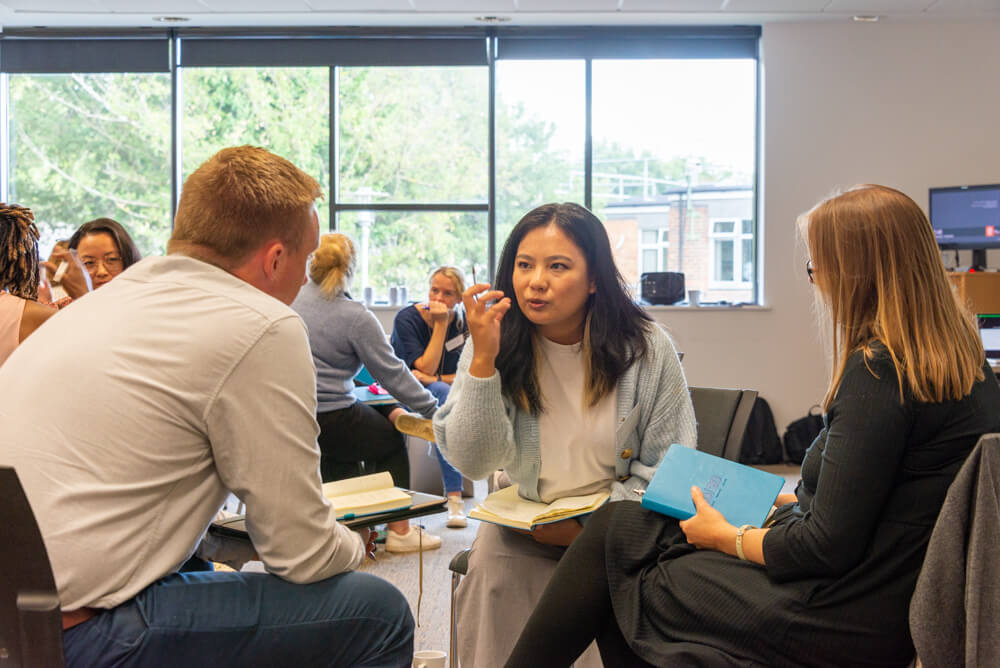
Being collaborative in the workplace is a skill and like all skills, it can be developed. The collaborative working skills we focus on most in our development work include:
- Active listening and genuine curiosity about others’ perspectives
- The ability to give and receive honest, constructive feedback
- Facilitation skills – being able to bring a group together and help them think and decide well
- Managing competing priorities and interests across different stakeholder groups
- Holding disagreement productively – being able to debate without breaking relationships
- Knowing how you collaborate with other teams – understanding interdependencies and maintaining healthy working relationships across organisational boundaries
How does collaborative working support others?
There’s a question worth sitting with here: how does collaborative working support others beyond just getting tasks done faster? At its best, collaboration is a developmental experience. Working alongside others exposes people to different ways of thinking, challenges assumptions, builds empathy and accelerates learning. People who work in genuinely collaborative cultures tend to grow faster, feel more valued and stay longer.
Why team collaboration is important goes beyond productivity: it shapes how people experience their work, and whether they feel they belong and matter within an organisation. This is why investing in collaboration is not just a performance lever, it’s a human one.
How to overcome collaboration challenges
Based on ten years of working with organisations to build stronger collaborative cultures, here’s our honest advice:
- Start with leadership – collaborative cultures don’t just happen; they’re modelled and shaped by the people at the top. Leaders who invest in their own collaborative leadership approach create a ripple effect throughout the organisation.
- Invest in relationships, not just processes – tools and structures matter, but trust is built through human connection. Create deliberate opportunities for people to know each other as people, not just colleagues.
- Design your ways of working intentionally – collaboration rarely improves by accident. Think carefully about meeting rhythms, feedback practices, decision-making processes and how information flows across your organisation.
- Make it safe to speak up – address the culture conditions that prevent honest dialogue. Psychological safety is the bedrock on which everything else is built.
- Get external support – sometimes an outside perspective, or a skilled facilitator, is what’s needed to break through patterns that have become embedded. This is where partners like CoCreate can make a real difference.
Final Thoughts
Collaboration is one of those things that everyone wants more of, but that few organisations invest in seriously enough. It requires deliberate attention to culture, leadership, relationships and ways of working. It won’t be solved by a new software platform or a one-off team event.
What it does require is a genuine commitment from leaders to create the conditions in which people can bring their best thinking, their honest voice and their full effort to the challenges that matter most.
At CoCreate, our mission is to bridge the gap between the culture organisations want and their capacity to create it. Over the past ten years, we’ve helped leaders and organisations build the mindsets, connections and cultures needed to thrive in a complex world, and collaboration has been at the heart of all of it.
If you’re ready to take the next step, we’d love to talk.