



Enneagram 9 at Work: The Adaptive Peacemaker
If you’re an Enneagram 9 or you work with one, this will feel familiar.
Work is rarely just about tasks or outcomes for a 9. It’s also about atmosphere, tone and belonging. Who is included? Is anyone being overlooked? Is there tension in the room? Are people feeling heard and respected?
Enneagram Type 9, often called The Adaptive Peacemaker, shows up at work as the person smoothing edges, lowering the temperature and helping teams find common ground. They bring steadiness, receptivity and a calming presence to groups. This is not because 9s lack opinions or ambition, but because they are deeply motivated to maintain harmony and minimise conflict, tension and disruption.
At their core, 9s are driven by a powerful need: to keep the peace. When this need is met, Type 9 becomes a grounding and integrative force – someone who helps groups function well together, especially in complex or emotionally charged environments.
What does Enneagram 9 look like at work?
Enneagram Type 9s bring calm, steadiness and diplomacy into their working lives.
They are often easy to work with: open, unassuming, patient and fair. 9s have a natural ability to listen to multiple perspectives, synthesise complexity and find common ground within difference. In meetings and group settings, they are often quietly tracking what is happening between people rather than pushing a personal agenda.
Enneagram 9 does not just value harmony – they perceive the world through a broad, inclusive lens. Their attention naturally widens to take in multiple people, groups and agendas simultaneously. They notice dynamics, alliances, tensions and who is being included or excluded. This makes them highly attuned to relational systems, even if they struggle to articulate their own position within them.
As a body type, 9s’ energy follows attention. Because their attention so often goes outward – toward others’ needs, plans and priorities – they can lose contact with their own. They may “go with the flow” not because they don’t care, but because asserting themselves can feel disruptive or risky.
Many 9s value order, rhythm and predictability. Routine can be stabilising and comforting. A Self-Preservation 9 I worked with embodied this beautifully: a gentle, self-deprecating humour, deep appreciation for simple pleasures, and genuine contentment in familiar routines, such as watching the same soap opera for decades because it feels safe and grounding.
Core Fear
At the heart of Enneagram 9 is a core fear of being in conflict or being controlled.
Conflict feels like separation. Control feels like being pushed aside. Many 9s carry an implicit belief that asserting themselves too strongly will lead to disconnection, escalation or being overridden.
This fear helps explain why 9s can be deeply uncomfortable around intense or confrontational energy, particularly the energy of Type 8s. Where an 8 instinctively moves toward conflict, a 9 often moves away from it.
Over time, this avoidance can create a quieter emotional cost. When 9s repeatedly set aside their own needs to preserve harmony, they may experience a sense of isolation, sadness or “fading into the background.” Belonging matters deeply to 9s, especially Social 9s, and the fear of losing connection can be profound.
Motivations
Enneagram 9s are motivated by harmony, inclusion, stability and ease.
They want environments that feel respectful, calm and non-threatening. They are often driven to keep people happy, reduce friction and prevent escalation. Their attention goes to who is being heard, whose needs are being prioritised and how decisions are landing across the group.
They also value comfort and predictability. This can make them reliable and steady contributors, particularly in environments where consistency matters. However, when change threatens equilibrium, 9s may delay, disengage or hope issues will resolve themselves without direct intervention.
A common pattern is that 9s trust others until they see evidence that trust is misplaced – but they may not communicate this shift directly. Disagreement can go underground rather than being expressed overtly.
Strengths
At their best, Type 9s bring calm authority, integration and relational intelligence.
They are agreeable and grounding. Their presence reduces anxiety and helps people feel at ease.
They are understanding and inclusive. Nines genuinely hold multiple perspectives and help teams integrate difference rather than polarise.
They are patient and even-keeled. Type 9s trust timing and work at a steady pace, which can be invaluable in long-term or complex initiatives.
They are supportive and empathic. Because they accept others as they are and see potential rather than flaws, people feel heard and valued in their presence.
From an organisational perspective, 9s are often natural systems integrators. In complex environments, they notice how different groups are collaborating – or failing to – and instinctively move to facilitate connection and coherence across boundaries
This pattern can be seen in leaders often associated with Type 9, such as Barack Obama, whose leadership emphasised calm authority, synthesis and a consistent drive to hold unity and common ground in the face of division.
Weaknesses under stress
Under stress, Enneagram 9s’ strengths can become limiting.
Their conflict-avoidance can delay necessary conversations. Over time, this allows frustration to build beneath the surface.
They can be unassertive or indirect, especially with feedback. Worrying about how their words will land, they may soften messages to the point where meaning is lost.
A key blind spot is not a lack of awareness, but distortion of attention. Because 9s see many things as equally important, prioritisation becomes difficult. Urgency flattens. Action stalls.
Anger is often underdone or repressed. 9s may not recognise it until it leaks out through stubbornness, procrastination, withdrawal or passive aggression. Almost every 9 I’ve met smiles knowingly when I’ve asked them if passive aggression resonates! Occasionally, anger erupts suddenly after long suppression, much like a volcano.
I worked recently with one Senior Team with a strong 9 presence in which irritation, frustration and resentment were widespread but unspoken. To address this, they introduced structured check-ins at the start of their weekly meetings – explicitly inviting people to name what was really going on for them. This really helped bring what was simmering underground into the open in a way in which it could be attended to.
Enneagram 9 in conflict: how do they respond?
Conflict is deeply uncomfortable for most Enneagram 9s.
They may try to smooth, mediate or neutralise disagreement, or they may disengage as a way to self-regulate. Sometimes they agree externally while disagreeing internally.
If a 9 feels pressured or controlled, resistance often shows up passively – through delay, withdrawal or quiet immovability rather than open opposition.
9s generally handle conflict best when there is psychological safety and explicit permission to be honest without escalation.
Enneagram 9 in teams and professional relationships
In teams, 9s often play a stabilising and connective role.
They are cooperative, supportive and generally well-liked. They help groups feel cohesive and steady during uncertainty. I’ve seen this recently with a Chief Executive who is leading their organisation through a major restructure involving a significant number of redundancies. The feedback from staff – despite the uncertainty and concerns about their personal feedback – has consistently been that the Chief Executive couldn’t have been more supportive, fair, human, approachable and transparent through what is a difficult process.
However, 9s may struggle to claim their space. Stronger personalities can dominate, while 9s’ perspectives remain unspoken.
In relationships, Enneagram Type 9s value closeness and harmony. They may merge with others’ preferences – particularly SX 9s – and lose touch with their own. Dissatisfaction may show up as quiet resignation rather than direct expression.
Enneagram 9 jobs: what roles and leadership contexts suit this type?
Type 9s often thrive in roles involving facilitation, diplomacy, people leadership, organisational development, partnership working and stakeholder engagement.
They do well where:
- Relational intelligence matters
- Complexity needs integrating
- Stability and inclusion are valued
Highly confrontational or aggressively political environments can be exhausting unless 9s have strong support and authority.
Growth and development for Type 9 leaders
Growth for Enneagram 9 centres on turning attention back toward self.
Rather than changing who they are, 9s grow by learning to look at their lens as well as through it – recognising how their perceptual habits shape their choices.
Development involves bringing what is hidden or underground into awareness: personal priorities, preferences, boundaries and anger. Because so much can be muted or diffused, this often requires time, reflection and good questions.
Key growth edges include:
- Spending time alone to reconnect with self
- Practising direct, clear communication
- Naming anger early, before it leaks out
- Prioritising and choosing, even when it feels uncomfortable
- Stepping into visibility (accessing their line to Enneagram Type 3): here’s who I am and what I bring
Under pressure, 9s may move toward 6 – becoming anxious, doubtful and overly influenced by others’ views. Growth involves interrupting the “go along” reflex and injecting appropriate doubt: Do I actually agree? What do I want here?
At higher integration, 9s remain peaceful – but no longer disappear. They become quietly confident, grounded and self-respecting.
Enneagram 9 subtypes at work
Type 9s express self-forgetting differently depending on instinct.
- Self-Preservation 9s numb through comfort, routine and familiarity. Often warm and humorous but may neglect growth or health in favour of ease.
- One-to-One 9s merge deeply with significant others. Most likely to lose self in relationship. Growth involves repeatedly “coming home” to oneself.
- Social 9s merge with groups or causes. Highly active and capable of leadership, yet can overlook personal needs due to constant outward focus.
All three share the same core motivation but can look very different day to day.
When Type 9 shapes organisational culture
At its best, a Type 9 culture is inclusive, calm and collaborative. People feel safe, respected and able to contribute. Differences are integrated rather than polarised.
At its worst, it becomes conflict-avoidant and passive. Issues go underground. Decisions stall. Tension increases.
Healthy cultures balance Enneagram 9 harmony with clarity, challenge and directness.
Drive change with the iEQ9 Enneagram
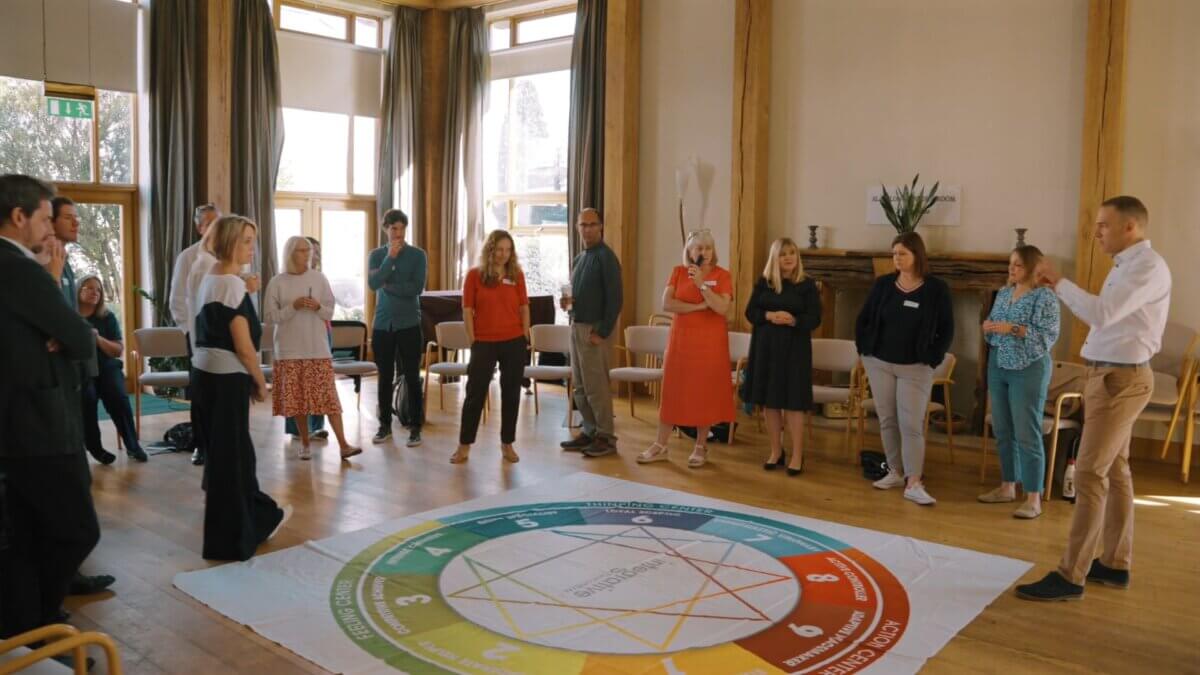
CoCreate is the UK’s largest and most experienced iEQ9 Enneagram provider for businesses.
We work with Enneagram Type 9 leaders, alongside all other types, across sectors, supporting senior leaders, teams and organisations through coaching and leadership development.
Discover our Enneagram services for business leaders and teams.
Want to continue exploring the Enneagram?
If you want to learn more about the Enneagram, each of the types or how you can harness the power of the Enneagram, here are some resources you might find useful:
If you would benefit from a coaching conversation, want to understand your Enneagram type more deeply, or are curious about how the Enneagram can accelerate team performance, get in touch.