



Leadership team performance under pressure: What studying 34 Executive Teams reveals
What executive teams say they need
Across every sector, when we speak with executive teams, three themes come up again and again:
- Better decisions
- Stronger accountability
- Greater resilience under pressure
Boards expect it. Regulators scrutinise it. Markets test it. Staff feel it.
Yet when we analysed 34 senior leadership teams using the iEQ9 Enneagram, over 250 executive leaders across healthcare, pharma, consulting, media and technology, something more consistent started to show up.
Not capability gaps.
Rather the same patterns repeated across executive teams, including:
- A tendency to avoid overt conflict, until something forces it into the open
- A strong instinct for self-preservation at the top
- A preference for focusing on the positives and less so on the risks
- A discomfort with emotional openness and authenticity
We’ll come back to each of these.
For now, what matters is the effect.
Under pressure, debate narrows. Agreement comes faster than it should. Risk is managed procedurally rather than worked through collectively. The harder conversations move outside the room. Strengths start to overplay.
The teams responsible for navigating complexity can become less balanced as that complexity increases.
To understand why, we have to look beneath behaviour.
The lens: why motivation matters
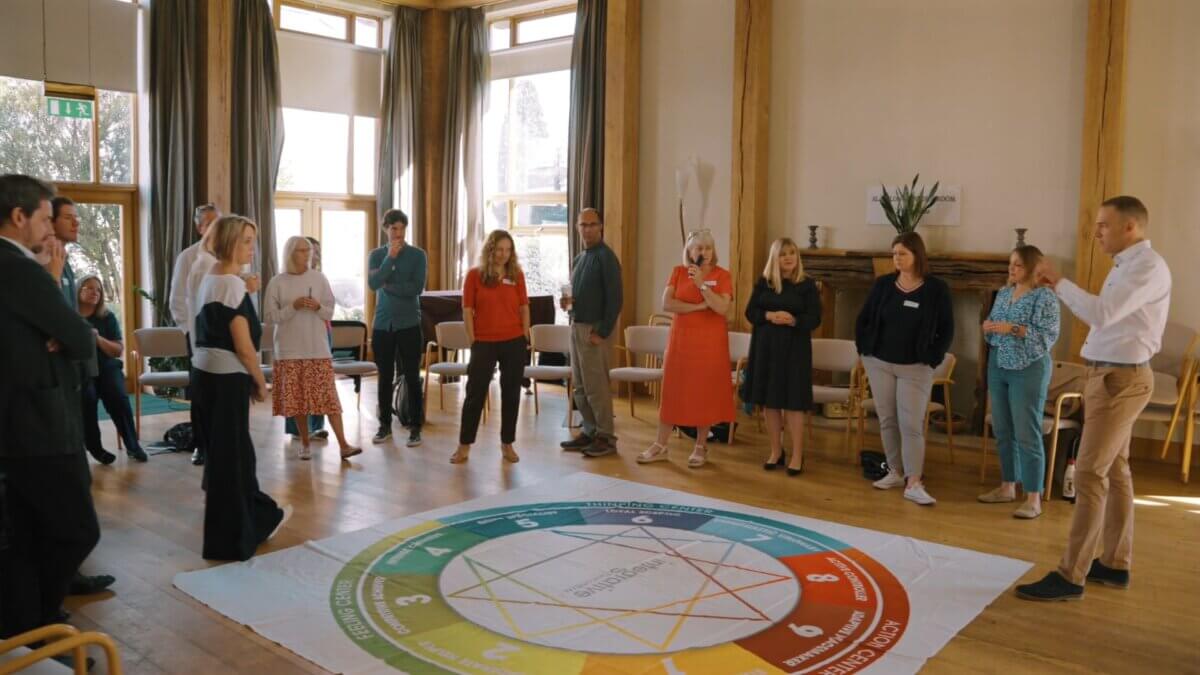
The iEQ9 Enneagram looks beneath behaviour to motivation.
Not just what leaders do, but what they prioritise, avoid and become reactive to when uncertainty increases.
Most executive development focuses on observable behaviours. The Enneagram focuses on the internal drivers shaping those behaviours, especially under pressure.
Leadership teams often appear aligned on the surface. Beneath that alignment sits a motivational distribution that determines how conflict is handled, how risk is interpreted and what gets avoided.
When pressure rises, those patterns intensify.
We hear examples of these patterns frequently during our pre-event one-to-one conversations. At the start of one workshop with a European executive team, we shared a slide summarising what we had heard from team members beforehand. The comments pointed to a lack of psychological safety, a sense that it was not safe to disagree, and a belief that the CEO tended to steamroller colleagues in debates.
As we shared the slide, the CEO looked at us, slightly confused.
“These comments are a case study from another company, right?”
He was surprised to learn that every comment had come from the team members sitting around the room.
Leaning forward, he asked what he needed to do.
“Let’s start with motivation and go from there,” we told him.
The nine core motivations
The Enneagram describes nine core motivational orientations that shape how leadership teams focus attention and expend energy:
- Type 1 – Disciplined structure: commitment to standards and doing things properly
- Type 2 – Relational support: attention to care and connection
- Type 3 – Smart effectiveness: drive toward outcomes and success
- Type 4 – Creative originality: sensitivity to authenticity and new ways of seeing
- Type 5 – Technical specialisation: preference for expertise and analysis
- Type 6 – Risk awareness: vigilance about uncertainty and what could go wrong
- Type 7 – Enthusiastic networking: orientation toward possibility and future options
- Type 8 – Active control: instinct for decisiveness and making things happen
- Type 9 – Adaptive mediation: focus on inclusion and cohesion
Every leadership team contains a distribution of these motivations. That distribution creates capability and predictable imbalance.
Across 34 executive teams, several patterns recur.
The structural blind spots

No shared definition of productive disagreement
Executive teams talk about accountability, yet rarely agree on what healthy conflict looks like. Some motivations prioritise logic. Others prioritise harmony. Others are comfortable with intensity.
Without shared understanding, teams default to assertion or avoidance. Accountability is expected, but challenge is inconsistently practised.
Over-indexing on action
Many executive teams cluster around achievement, decisiveness and forward motion. This creates pace and clarity. It can also mean deeper analysis or risk testing is underweighted.
Under pressure, pace increases and debate shortens.
Underrepresentation of creative originality
Fewer than 6% of leaders in our dataset operate primarily from Type 4, creative originality.
This motivation brings tolerance for ambiguity and emotional disruption. When scarce, teams converge quickly and default to incremental innovation. Breakthrough thinking requires staying with discomfort. Many teams struggle to do so collectively.
Underdeveloped risk awareness
Fewer than 8% operate primarily from Type 6, risk awareness.
Governance processes exist. What is weaker is the collective habit of stress testing assumptions before momentum takes over. Under scrutiny or rapid change, this gap becomes visible.
Tendency toward self-preservation
Strong executive cohesion supports strategic focus. Yet a strong instinct for self-preservation also risks creating distance from the wider organisation. Over time, connection and credibility erodes.
Why this matters now
Leadership teams are operating in volatile, high-scrutiny environments. Under pressure, dominant motivations intensify and blind spots widen.
Harvard Business Review research suggests that only 10 to 15% of senior leaders are genuinely self-aware. Collective self-awareness improves decision quality, psychological safety and resilience.
The Enneagram provides a systemic lens on how leadership teams are configured, and where imbalance may be narrowing performance.
At team level, the value is practical. Teams gain clarity about collective strengths, predictable derailers and structural imbalance, particularly when stakes are high.
Let’s return to the European executive team we introduced earlier. By the end of the two-day workshop, the CEO had begun to see how his instinct to be strong and in control was shaping discussions, decision-making and overall team dynamics.
His commitments to the team were significant and meaningful, to listen more, to invite challenge and to ask more neutral questions rather than pushing quickly toward decisions. Something had shifted.
The conversation about conflict that followed was one he later described as one of the most significant leadership discussions he had ever been part of.
As the global Chief Executive for the business later reflected:
“The iEQ9 has been a breakthrough for our top teams, enabling more impactful discussions about individual development and team dynamics. It is a powerful way to drive towards a high-performing team that really understands itself.”
What we will explore next
In future articles, we will examine in greater depth:
- Why executive teams struggle with real conflict
- How motivational imbalance shapes decision making
- The cost of low creative originality
- Risk awareness and leadership resilience
- The link between self-awareness and psychological safety
The CoCreate approach
At CoCreate, our focus is not on fixing leaders. It is on changing the conditions in which leadership teams operate.
Our iEQ9 Enneagram leadership programmes help teams recognise dominant motivational patterns, close collective blind spots, rebalance action, feeling and thinking, and build the capacity to work productively with challenge, risk, and difference.
If you would like to explore this further, you can read our case study on how the iEQ9 supported global leadership transformation at Burda International or contact us to discuss how we support leadership teams navigating complexity and change at pace.