



The Enneagram: Why understanding motivation transforms leadership
Imagine this. You are happily dozing in bed at 7 am on a sunny Saturday morning when the sound of your neighbour’s lawnmower cuts through the air and jolts you awake.
Groggy and frustrated, you wonder what possible reason there could be for this intrusion. Most likely, there’s not one. At best, your neighbour is selfish, at worst, just downright vindictive.
But what if there was a good reason?
What if you knew they had a young child seriously ill in hospital and were trying to steady themselves? Or they were preparing to host the whole street for a garden party later that day? Or perhaps they had borrowed your lawnmower and felt compelled to return it as soon as possible?
Would that information soften your reaction?
You might still be annoyed, but as you understand the intention driving the behaviour, your response shifts. Empathy appears. Perspective appears.
This is the power of understanding motivation. It moves us from judging behaviour through our own worldview towards appreciating what is driving someone else’s actions.
At work, this dynamic is playing out all the time, often without us realising it.

Why motivation is the foundation of leadership agility
According to Heidrick and Struggles, 93% of executives agree that agility is critical to business strategy.
But agility is not a solo endeavour. It requires alignment, trust, and collaboration across leadership teams. While agile methodologies and processes matter, working effectively at pace depends on confidence in the intentions and actions of others.
And this is where things often break down.
Because we fail to understand what is driving our colleagues, we end up judging their behaviour. Sometimes silently. Sometimes in private conversations with others. Occasionally, out loud.
How often have you found yourself thinking:
- Why on earth are they so risk-averse and negative?
- Why are they always taking control?
- Why did they take credit for that piece of work?
- Why are they avoiding the difficult decision?
- Why do they keep pulling us back into detail when we need to look ahead?
- Why are they always so positive? Do they not see the issues we are facing?
When we do not understand what drives someone, we interpret their behaviour through our own lens. We project our own values, priorities, and motivations onto them.
That is where misunderstanding, mistrust and tension begins, which in turn reduces alignment, undermines buy-in and erodes agility.
Why motivation is the missing piece in leadership
If motivation is so fundamental, why is it so often overlooked in leadership?
One reason is that senior leaders are often among the least self-aware people in organisations. Research widely cited by Harvard Business Review suggests that in a study of 3,600 senior leaders, only around 10-15% were genuinely self-aware.
As leaders progress, they receive less honest feedback. Power distorts information. Even when leaders actively ask for feedback, others may not feel safe enough to give it. Over time, leaders can begin to believe their own narratives about themselves, narratives that are not always shared by those around them.
When leaders lack self-awareness, something predictable happens. They interpret other people’s behaviour through their own motivational lens, without realising they are doing it. They assume that what matters to them should matter to everyone else.
This is where familiar tensions show up at senior levels.
- Transformation programmes stall because leaders cannot align on risk and pace. Some are driven to act quickly and seize momentum, while others are scanning for what could go wrong. Each side experiences the other as either reckless or obstructive.
- Strategy discussions become circular as some leaders focus on future opportunity while others keep pulling conversations back to today’s operational realities.
- Restructures miss the mark as leaders protect their own functions or people, while telling themselves they are acting rationally.
- Innovation slows because disagreement becomes personal rather than productive, or because challenge is avoided altogether.
- People leave organisations not because of workload, but because they feel unseen, misunderstood, or judged.
At the root of these challenges is unexamined motivation.
When we are unaware of what drives us, it drives us. We react rather than choose. Awareness creates choice. Without it, adaptation is impossible.
Introducing the Enneagram
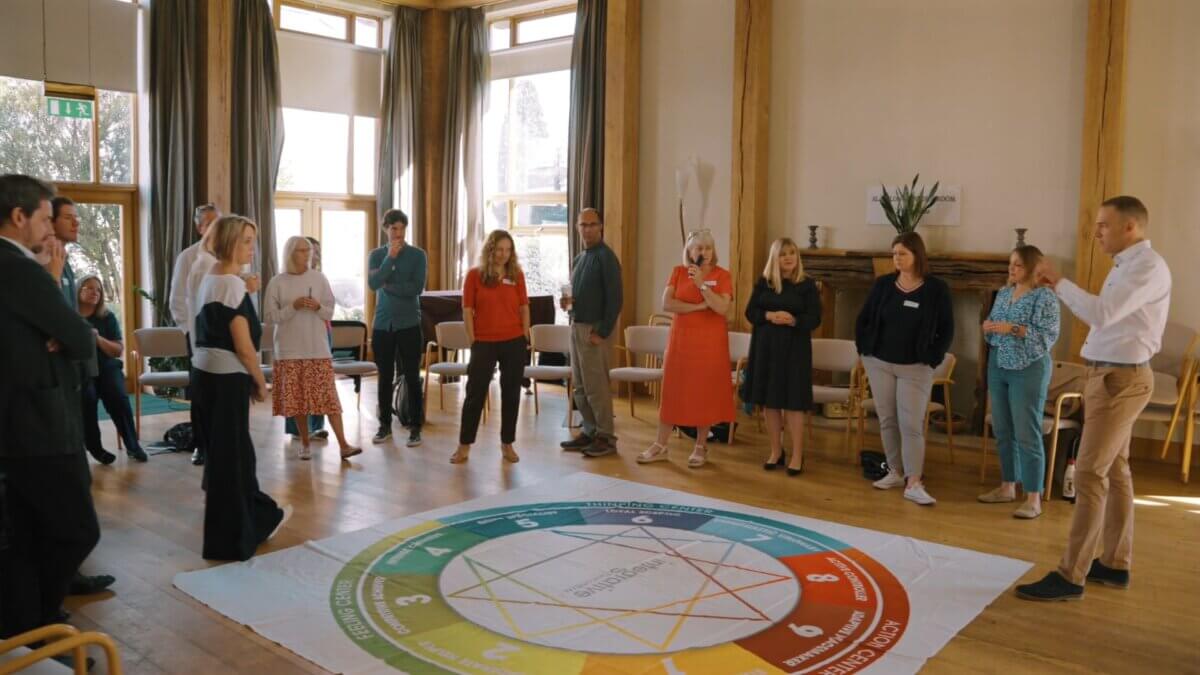
The word Enneagram comes from the Greek words for nine and figure. It is represented by a nine-sided symbol that maps nine distinct motivational patterns and the dynamic relationships between them.
Unlike most modern psychometric tools, the Enneagram did not originate in corporate psychology. Its roots are often traced back to ancient wisdom traditions, including Sufi mysticism, where it was used to understand human nature, consciousness, and development.
Over time, these insights have been integrated with modern psychology and applied to leadership, organisations, and personal development.
What has endured is a simple but powerful idea. Human beings are driven by a small number of core motivations. These motivations shape how we see the world and how we respond to it, especially under pressure.
Enneagram types explained: the nine motivations
At the heart of the Enneagram are nine core motivations. Everyone has access to all nine, but one dominates and becomes the lens through which we experience the world.
These motivations are:
- Enneagram Type 1: Strict Perfectionist – To be good, to do the right thing.
- Enneagram Type 2: Consideration Helper – To be liked, needed, and appreciated.
- Enneagram Type 3: Competitive Achiever – To achieve and to succeed.
- Enneagram Type 4: Intense Creative – To be authentic, unique, and understood.
- Enneagram Type 5: Quiet Specialist – To understand, to be self-sufficient.
- Enneagram Type 6: Loyal Sceptic – To be safe, secure, and to belong.
- Enneagram Type 7: Enthusiastic Visionary – To experience life fully and avoid pain and limitation.
- Enneagram Type 8: Active Controller – To be strong and in control, to avoid being vulnerable.
- Enneagram Type 9: Adaptive Peacemaker – To keep the peace and maintain harmony.
These motivations are not labels. They are deep organising principles. They shape what feels threatening, what feels meaningful, what we move towards, and what we avoid.
Two people can behave in the same way for completely different reasons:
- One person may work late because they want to succeed.
- Another because they do not want to let people down.
- Another because they want to feel safe.
- Another because they want to be in control.
Without understanding the motivation, behaviour alone is misleading.
Using the iEQ9 Enneagram to support leadership growth
The Enneagram is not a lightweight or comfortable tool. Done well, it is confronting, stretching, and deeply illuminating.
It shines a light not only on our strengths, but also on the patterns that limit our effectiveness and relationships. It helps leaders see the unconscious strategies they rely on under pressure.
This is where iEQ9 comes in.
iEQ9 is a robust, psychometric assessment grounded in the Enneagram, designed specifically for leadership and organisational development. It brings rigour, precision, and a growth-focused lens to Enneagram work, making it suitable for senior leaders and complex systems.
Working with CoCreate using the iEQ9 tool has been a significant breakthrough, particularly with the top team. Every member of the team was taken aback by the accuracy and depth of insight into their type, subtypes, strengths, and blind spots. It enabled more open, more impactful conversations and accelerated the pace at which the team developed.
TOM BUREAU, CEO, BURDAINTERNATIONAL
Used well, type is not a box. It is a pathway for development. It shows leaders where they habitually operate from, and where their greatest growth potential lies.
Applying the Enneagram at work
This is where insight turns into impact.
When leaders understand motivation, they stop trying to fix behaviour and start working with what drives it.
Using iEQ9, Enneagram insight can be applied directly to leadership challenges such as decision making, strategy, conflict, feedback, and collaboration.
Leaders become more flexible in how they lead. Teams develop a shared language for difference that reduces judgement and increases trust. Challenge becomes healthier.
Decisions become clearer and more timely.
The result is not harmony for its own sake, but stronger leadership and greater organisational agility.
A real-world example
Immediate Media was navigating significant transformation as it accelerated its shift towards digital delivery. For senior leaders, success depended less on having the right strategy and more on how effectively the Extended Leadership Team could work together under pressure.
While the Executive Team had already experienced the value of the iEQ9 Enneagram, the wider leadership system needed a shared language, stronger trust, and the confidence to challenge at pace.
Using iEQ9 as a common lens, leaders began to understand what was driving themselves and others. Conversations shifted. Challenge became more constructive. Trust increased across the leadership community.
The impact was tangible:
- 100% said the programme supported their development as a leader
- 91% reported greater trust and psychological safety
- 91% said leadership effectiveness increased
The Enneagram has been incredibly powerful. Extending it to the Extended Leadership Team was a no brainer. People are embracing it, enjoying it, and using it. It leads to better conversations, stronger challenge, and it genuinely drives performance.
SEAN CORNWELL, CEO, IMMEDIATE MEDIA
Why motivation changes everything
When leaders understand motivation, they stop reacting to behaviour and start responding to what is really driving it.
They make better decisions. They handle conflict more productively. They build trust faster and sustain it under pressure.
The Enneagram, and tools such as iEQ9, give leaders a language for difference that goes beyond personality and preference. They create awareness where assumption once lived, and choice where reaction once dominated.
In organisations facing constant change, that level of understanding is no longer optional. It is a leadership capability.
Drive change with the iEQ9 Enneagram
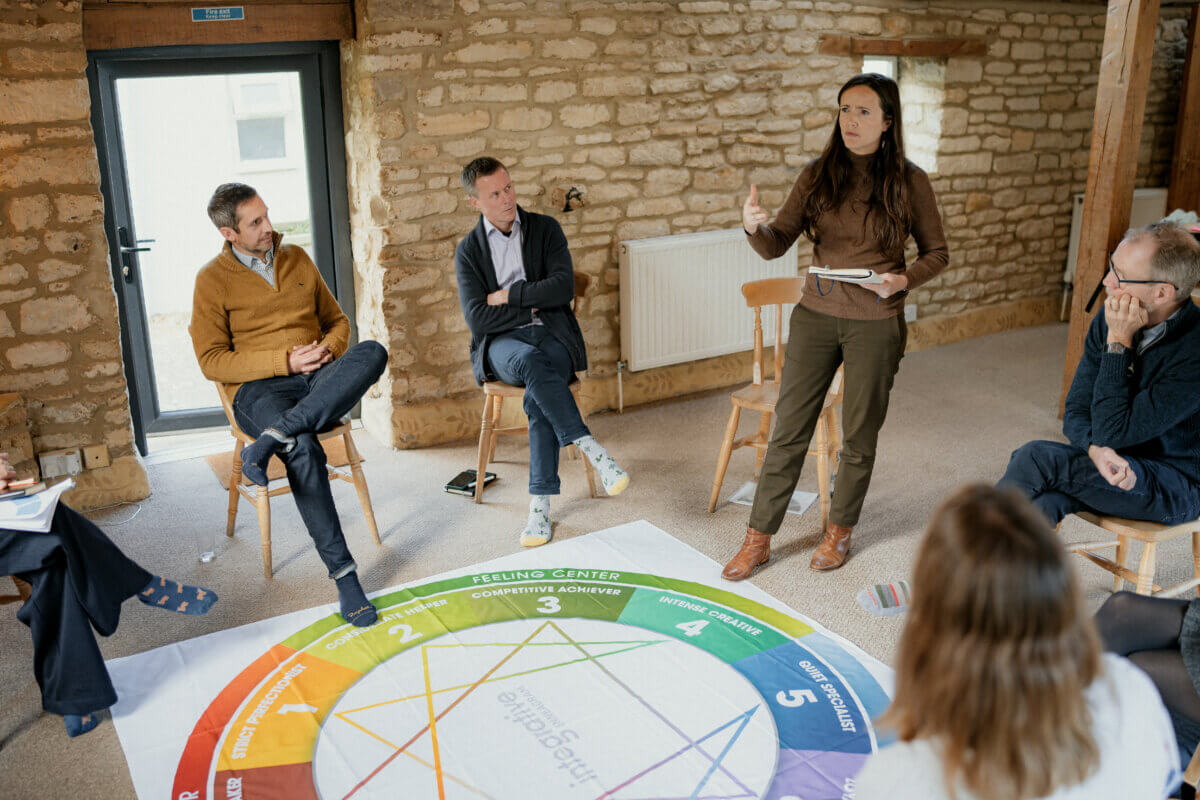
CoCreate is the UK’s largest and most experienced iEQ9 Enneagram provider for businesses. We support senior leaders, teams and organisations across sectors through coaching and leadership development.
If you want to explore how Enneagram insight and iEQ9 are used to develop leaders and leadership systems, you can learn more here:
Discover our iEQ9 Enneagram services for business leaders and teams.
Want to continue exploring the Enneagram?
If you want to learn more about the Enneagram, each of the types or how you can harness the power of the Enneagram, here are some resources you might find useful:
If you would benefit from a coaching conversation, want to understand your Enneagram type more deeply, or are curious about how the Enneagram can accelerate team performance, get in touch.